
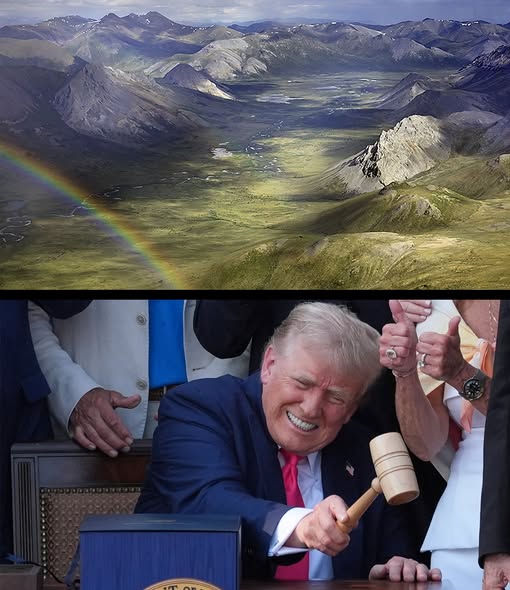
The recent auction of nearly 690,000 acres of Alaska’s pristine Arctic National Wildlife Refuge has ignited widespread outrage and disbelief. On this pivotal occasion, only two bidders showed up—both representing the oil and gas industry—yet neither actually committed to exploration. The bid netted a paltry $3.7 million, a far cry from what many had anticipated when this land was first opened to potential development. According to Alaska Public Media, this was the third auction attempt, and the 2025 sale drew zero bids altogether, illustrating a clear trend: even the fossil fuel industry is increasingly reluctant to sacrifice America’s last wilderness for profit.
The spectacle was almost darkly comic. Major industry players, often eager to cash in on natural resources, bypassed the event entirely, signaling a stark shift in attitude toward the Arctic Refuge’s fate. The absence of bidders and the minimal revenue highlight a growing skepticism toward exploiting this untouched landscape. Even the most profit-driven companies seem to be sending a strong message: this ecological treasure is not worth the environmental destruction, at least not anymore.
But this weak turnout, while seemingly a victory for conservation, masks the broader, relentless assault on the environment initiated by the current administration. Since January 2025, reports from the Sierra Club reveal a staggering loss of federal environmental staff—over 2,700 from the National Park Service, nearly 1,800 from the Fish and Wildlife Service, and 2,000 from the EPA. The rollback of critical protections, including gutting the Clean Air Act and weakening the Clean Water Act, signals a broad deregulation campaign aimed at prioritizing fossil fuel interests over environmental health and climate stability.
Furthermore, the United States’ withdrawal from the Paris climate agreement on day one of this administration’s tenure epitomized this stance. According to the Natural Resources Defense Council (NRDC), harmful environmental actions have been occurring at an unprecedented pace—roughly one every single day—highlighting a relentless disregard for environmental preservation. As critics argue, this administration seems intent on turning back the clock on decades of progress, even at the cost of irreparably damaging some of America’s last untouched lands.
Yet amidst this grim backdrop, resilience persists. The Gwich’in people, indigenous inhabitants of North Alaska whose culture depends on the Porcupine Caribou herd that calves on the coastal plains, continue their fight to protect the land. They emphasize that some areas are simply too vital to sacrifice—a stance rooted in cultural survival and ecological necessity. This ongoing indigenous resistance reminds us that the battle over the Arctic Refuge is not only about land but about respecting sovereignty and preserving ways of life that have endured for generations.
It is increasingly clear that this administration’s push to open the Arctic Refuge to oil and gas extraction isn’t driven by genuine market demand but appears to be an act of spite—an attempt to fulfill political ambitions at the expense of the planet’s health. The fact that even the fossil fuel industry is largely absent signals a paradigm shift: the era of reckless exploitation may be drawing to a close.
As public awareness grows and the impacts of climate change become more evident, the need to protect these last wild places has never been more urgent. The fight for Alaska’s Arctic Refuge underscores a critical crossroads in environmental policy—a choice between greed and preservation, destruction and stewardship. The question remains: will we heed the calls from indigenous communities, scientists, and environmental advocates before it’s too late?