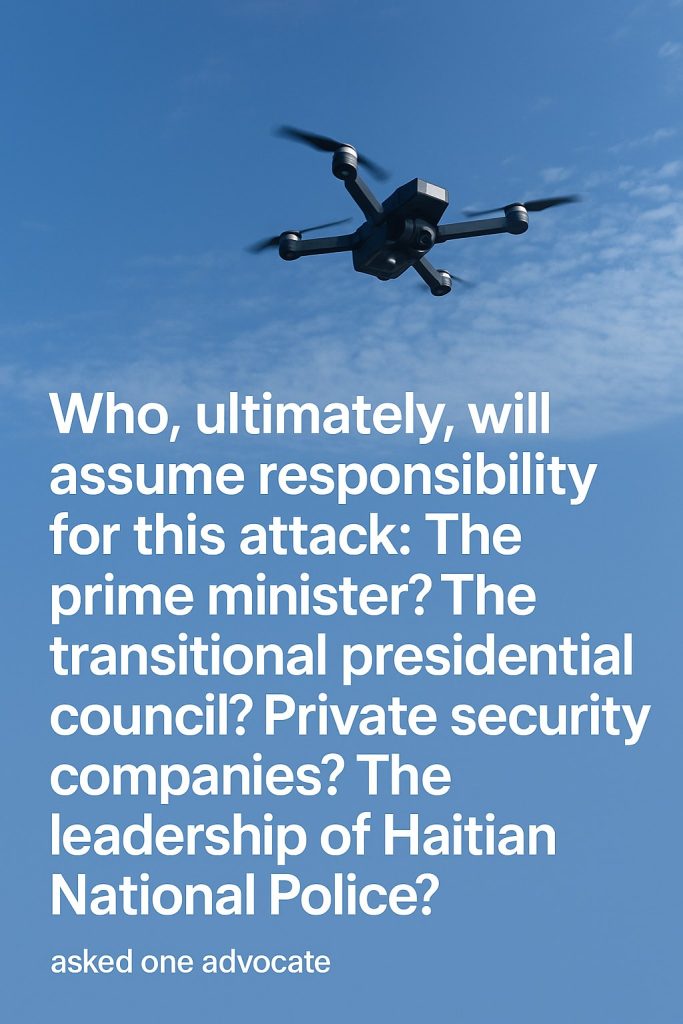
In the wake of a devastating attack that has shaken the Haitian community, the question looms large: who will ultimately bear responsibility? Activists and local leaders are now demanding answers from the highest levels of government and security forces, igniting a fierce debate on accountability and governance in a nation grappling with violence and instability.
The attack, which occurred just days ago, left multiple casualties and deepened the sense of insecurity in the capital, Port-au-Prince. With the origins of the violence still unclear, advocates are scrutinizing the roles of various actors: the prime minister, the transitional presidential council, private security companies, and the leadership of the Haitian National Police. As tensions rise, each entity’s involvement is coming under fire.
“Someone has to be held accountable,” stated human rights advocate Marie Claire Fréchets during a recent rally in Port-au-Prince. “We cannot allow this cycle of violence to continue while those in power evade responsibility.” Fréchets’ statement encapsulates the sentiments of many Haitians who feel abandoned by their leaders and let down by the very institutions meant to protect them.
The transitional government, established after the assassination of former President Jovenel Moïse in July 2021, has struggled to restore order amidst rampant gang violence. Critics argue that the prime minister’s administration has failed to implement effective security strategies, allowing criminal organizations to operate freely. The lack of accountability within the Haitian National Police has also been highlighted, with allegations of police complicity in gang activities further eroding public trust.
The role of private security companies adds another layer of complexity to this crisis. These entities, often hired to provide protection and maintain order, are now being scrutinized for their involvement in yesterday’s violence. Critics assert that these companies operate in a legal gray area and lack both the oversight and accountability that public security forces are supposed to uphold.
In response to the outcry, the prime minister’s office released a statement affirming its commitment to investigating the attack. However, many remain skeptical, pointing to previous instances where promises of accountability have not been fulfilled. “Words are not enough,” said activist Samuel Louis. “We need action and transparency so that this doesn’t happen again.”
Meanwhile, the international community has begun to take notice of Haiti’s deteriorating situation. Calls for support have intensified, with advocates urging foreign governments to assist in establishing a more robust police force and a clear plan for accountability. “It’s not just Haiti’s problem; it’s a regional issue that impacts all of us,” emphasized Fréchets.
As the investigation unfolds, the Haitian public is left grappling with uncertainty and fear in their daily lives. The question of accountability will likely remain at the forefront of discussions as people demand answers and solutions in a nation desperately seeking stability. Will Haiti’s leadership step up to take responsibility, or will the cycle of violence and impunity continue unabated?
Where to Learn More
- Haiti: Accountability for National Police Violations – Human Rights Watch
- Haiti’s Struggles After the President’s Assassination – BBC News
- Escalating Violence in Haiti: A Critical Overview – Al Jazeera
- Haiti’s PM Addresses Security Challenges – Reuters
- Understanding Haiti’s Gang Violence Epidemic – CNN