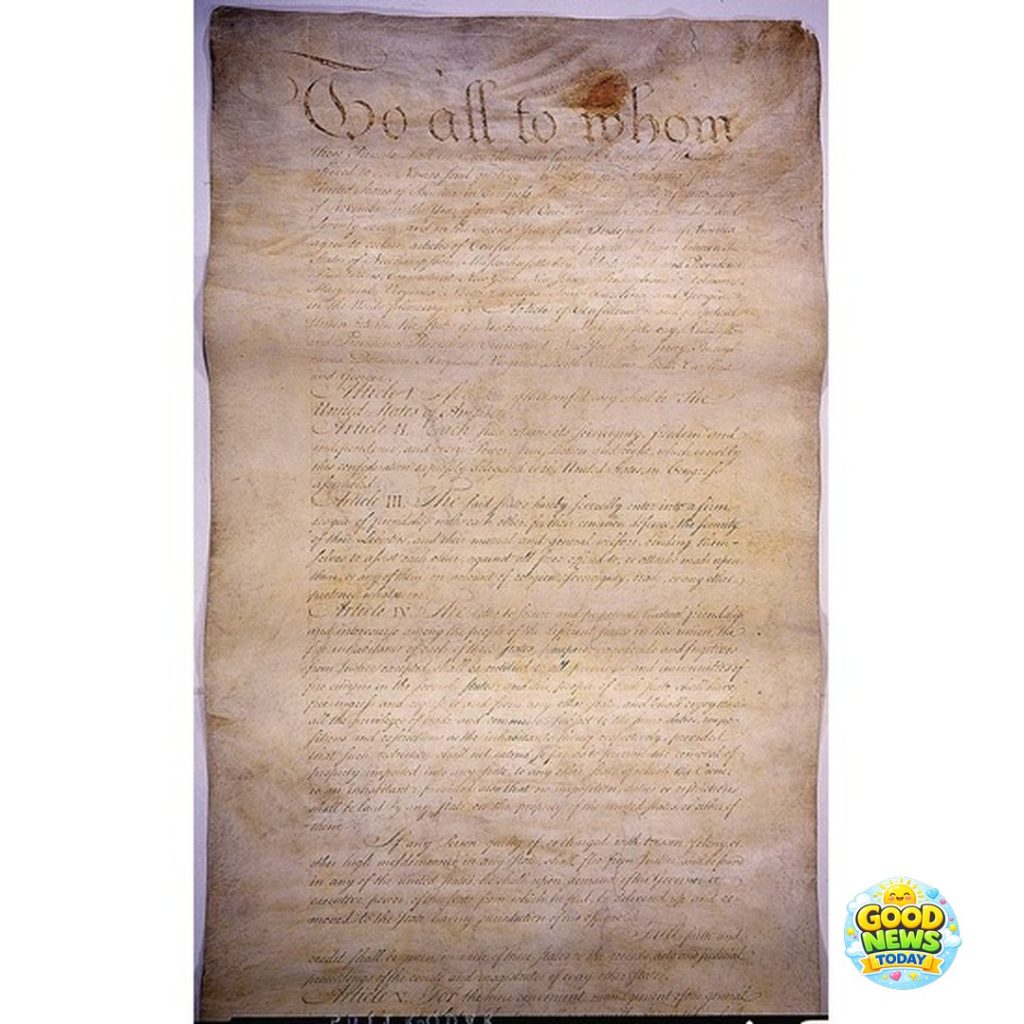
Today marks a significant milestone in American history, as 245 years ago, the Continental Congress adopted the Articles of Confederation after all 13 states ratified this foundational document. This momentous occasion established the Articles as the supreme law of the land in the wake of the American Revolution. The Articles created a unique and limited form of government, granting it only those powers that the former colonies had once recognized as belonging to the King of England. This meant there was no president, no executive agencies, and no judiciary, leaving no centralized tax system in place.

While often overlooked by historians and scholars, the Articles of Confederation were designed to delegate most powers to the individual states, with only a few specific responsibilities assigned to the central government. Among these were the management of war, military organization, foreign policy, treaty negotiations, and international trade.

The only centralizing elements were found in the first and thirteenth articles, which emphasized a “firm league of friendship” among the states and declared that the Articles would be “perpetual.”

In contrast to the later Constitution, which replaced the Articles, several sections of the Articles of Confederation highlighted ‘positive rights.’ While the Bill of Rights, consisting of ten ‘negative’ rights, states what Congress cannot do, Article 4 of the Articles aims “to secure and perpetuate mutual friendship and intercourse among the people of the different States in this union.” It also establishes “equal treatment and freedom of movement for the free inhabitants of each state to pass unhindered between the states,” showcasing the Founders’ intent through positive language.

This approach raises an intriguing legal question: who is responsible for guaranteeing these rights? While negative language can sidestep issues of sovereignty, positive language indicates that someone or something has the authority to grant rights, suggesting that the people must consent to that governance.
On this day, we also celebrate the 82nd birthday of Roger Daltrey, the iconic singer-songwriter of The Who. Known for his powerful voice and dynamic stage presence, Daltrey has left an indelible mark on rock music history. He not only helped create timeless classics like “My Generation” and “Won’t Get Fooled Again,” but he also earned a knighthood and a lifetime achievement award from the British Phonographic Industry.

Growing up in a working-class suburb of London, Daltrey formed lifelong friendships and musical partnerships with Pete Townshend and John Entwistle. His first guitar was a remarkable creation of his own design, crafted from a block of wood into an imitation cherry red Stratocaster.

Even though he faced challenges early on, including being fired by other members of The Who, Daltrey’s talent and determination have made him one of the most celebrated musicians of our time. Today, we honor both the historical significance of the Articles of Confederation and the incredible journey of Roger Daltrey.