
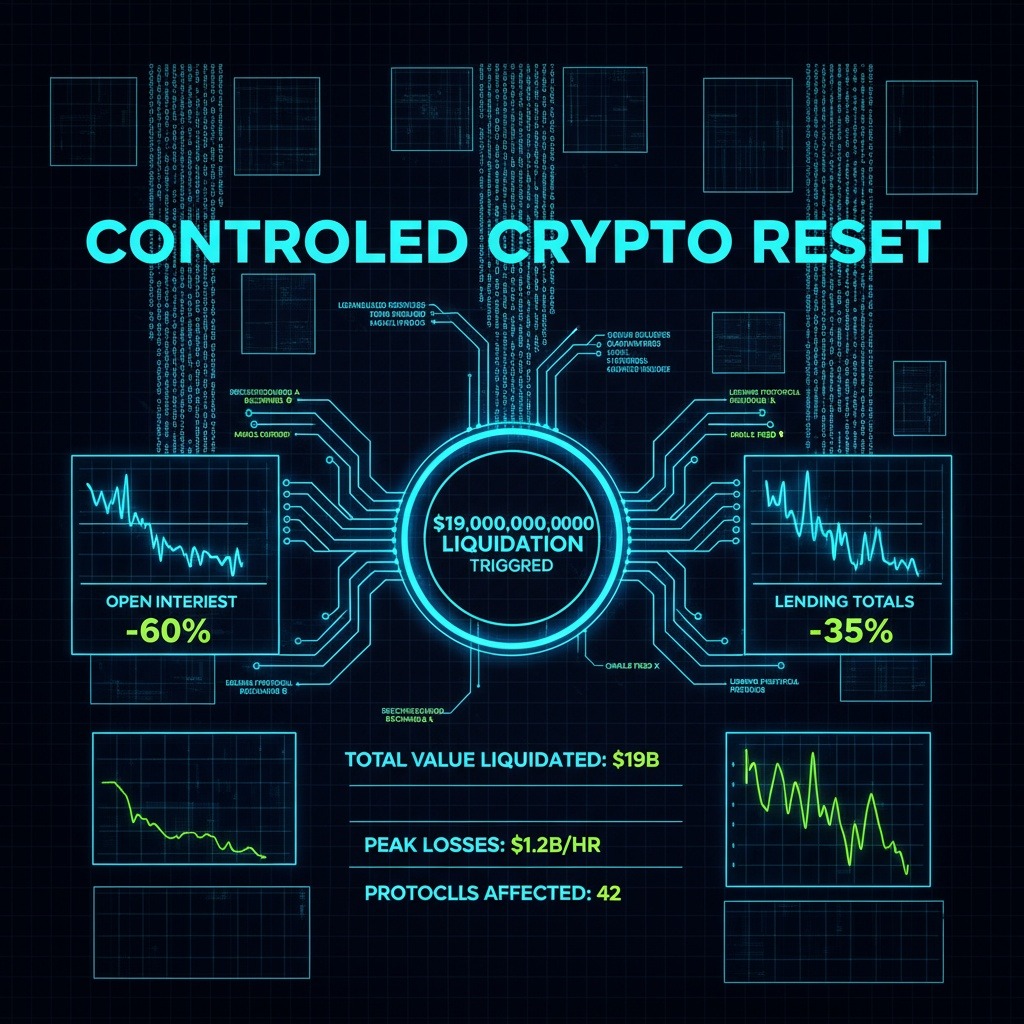
Friday witnessed an unprecedented $19 billion liquidation event across the cryptocurrency market, stirring debate among traders and analysts about the nature of the sharp downturn. While some market participants suggested a coordinated effort by major players to trigger a sell-off, blockchain data points to a primarily organic resetting of leverage.
During the flash crash, open interest in perpetual futures on decentralized exchanges (DEXs) plunged dramatically—from $26 billion down to under $14 billion—according to data from DefiLlama. Concurrently, trading fees on crypto lending protocols soared past $20 million in a single day, marking a new high, while weekly volumes on DEX platforms rose beyond $177 billion. Lending activity also slowed, with the total borrowed capital across lending platforms falling below $60 billion for the first time since August.
Despite claims from several traders that platform glitches or tactics by large market makers drove the crash, blockchain analytics depict a different story. Axel Adler Jr, an analyst at CryptoQuant, emphasized that more than 93% of the $14 billion open interest decrease occurred through a “controlled deleveraging” process rather than a chaotic cascade of liquidations. In fact, just $1 billion of the liquidated positions involved long Bitcoin (BTC) contracts, a signal Adler interpreted as an indication of the market’s increasing resilience.
Nevertheless, not all observers agree that the market movement was purely mechanical. Some market watchers have highlighted the role of liquidity providers in exacerbating the downturn. Blockchain researcher YQ noted a pronounced “liquidity vacuum” that emerged after market makers began withdrawing liquidity from exchanges shortly after 9:00 pm UTC on Friday—coinciding with a tariff announcement from former U.S. President Donald Trump.
Within 20 minutes, many tokens hit their daily lows, and the market depth for tracked tokens shrank drastically, dropping by 98% to just $27,000. This sharp decline in available liquidity likely intensified price swings. Coinwatch, another blockchain analytics platform, corroborated these findings, reporting a similar 98% contraction in market depth on Binance, the largest crypto exchange worldwide.
Further insights from Coinwatch revealed that following the price crash, some market makers completely withdrew their orders from the data books. Approximately 90 minutes after the crash began, one major market-making entity resumed normal operations, while another remained largely inactive for several hours. In one case involving a Binance-listed token valued at over $5 billion, two out of three primary liquidity providers reportedly disengaged for five hours during the crucial period.
Coinwatch has indicated ongoing communications with these key market-makers to encourage a more consistent return of liquidity support.
In summary, the $19 billion market correction appears to have been driven mainly by a substantial but orderly deleveraging phase, with liquidity fluctuations playing a notable amplifying role. Industry analysts continue to monitor developments to better understand the interaction between automated trading behaviors and large stakeholder actions during such high-volatility episodes.